Meetings begin at 6:15 PM.
- For meetings held by Zoom, instructions for joining the meeting will be emailed to members on the day of the meeting.
- Non-members can request that information by emailing philbotclub@gmail.com by 10 PM the day before the meeting.
If you have an idea for a future program, please contact the Program Committee chair, Rebekah Armstrong, rebekah.armstrong@gmail.com. A list of previous meetings is available.
Members’ reports on summer botanizing
At the first of the Philadelphia Botanical Club fall meetings, members are invited to share photos and news from our botanizing during the summer. We would like to see your photos!
If you are planning to show your photos at the meeting, please have them ready to email by noon on the 24th. If possible, consolidate your photos into a single PDF or PowerPoint file, but individual photos are also OK. We ask that you limit your slides to a maximum of 6, and your comments to at most 6 minutes.
Location: Pennsylvania Horticultural Society McLean Library, 100 North 20th Street, Philadelphia
Michaux Grove: Ecological Restoration within a Living Time Capsule

Veronica Magner, Landscape Manager with the Fairmount Park Conservancy, will speak about the history and current management of the Michaux Grove in Fairmount Park, Philadelphia.
Beginning around 1870, a collection of oaks was planted in West Fairmount Park near Horticultural Hall to commemorate André Michaux and his son François André Michaux, two pioneers of American botany. In 2012, David Hewitt and others rediscovered the grove: a collection of enormous, uncommon oaks amid a dense understory of multiflora rose, Japanese honeysuckle, poison ivy, and English ivy.
In 2018, Philadelphia Parks and Recreation, Fairmount Park Conservancy, and volunteers began removing invasive plants, installing fencing, and planting thousands of trees and shrubs at the site and in nearby areas. More recently, Veronica Magner has helped guide this effort while exploring what Michaux Grove had been and what it could become.
Photo credit: Veronica Magner.
Location: Pennsylvania Horticultural Society McLean Library, 100 North 20th Street, Philadelphia
Pond Scum Diaries: Connecting green algae, the origin of land plants, and an iconic collection at the Academy of Natural Sciences
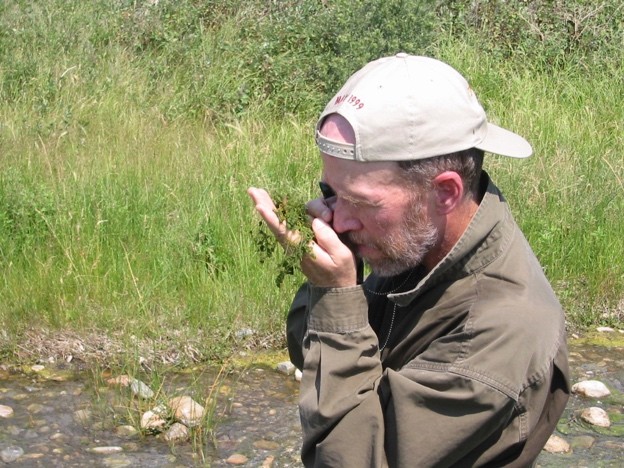
Dr. Richard McCourt, Botany Curator Emeritus of Botany at the Academy of Natural Sciences of Drexel University, has spent his career investigating the diversity and evolution of green algae. He also has a long-standing interest in the plant collection of the Lewis and Clark expedition, made on their iconic expedition in 1804-06, now housed primarily at the Academy of Natural Sciences. His talk will combine both themes, with an overview of the conjugating green algae such as Spirogyra and its relatives and their relationship to land plants, and a report on algae encountered on the Lewis and Clark expedition. He will also report on a recent find of some surprising Lewis and Clark specimens in London.
Photo: Rick examining the green alga Chara vulgaris in a hot spring on the Lewis and Clark trail.
Photo credit: Richard McCourt.
Location: Pennsylvania Horticultural Society McLean Library, 100 North 20th Street, Philadelphia